

Do You Need a Permit for a Business Sign in Summerville, SC?
In most cases, yes. If you are putting up a permanent sign, plan on a business sign permit in Summerville before anything is installed. Here is who reviews it, what they look at, and what to have ready so the application does not bounce back.
- Written by a Summerville sign shop
- Town of Summerville process explained
- What reviewers check, in plain terms
- No guessed fees or timelines
Most permanent business signs in Summerville, South Carolina need a sign permit before installation, including monument signs, wall and building-mounted signs, channel letters, pylon signs and any illuminated sign. Inside Town limits, the Town of Summerville Planning Department reviews sign permits, which are filed online through the Town's CitizenServe portal and measured against the Town's Unified Development Ordinance. Summerville spans Dorchester, Berkeley and Charleston counties, so the reviewing office depends on the exact address and whether it sits inside Town limits or in an unincorporated county.
Who issues a business sign permit in Summerville?
Inside Town of Summerville limits, the Planning Department. Sign permits are filed through the Town's online CitizenServe portal, where Sign Permit is listed as its own application type, and the standards come from the Town's Unified Development Ordinance. The Town asks applicants to contact the Planning Department before submitting an application, which is worth doing anyway.
The complication is geography. Summerville spreads across Dorchester, Berkeley and Charleston counties, so a property outside Town limits is reviewed by the county with jurisdiction instead. Two businesses a few miles apart can be working under two different rule sets. Before you spend money on design, settle two things:
- Which jurisdiction your address falls under, Town or county
- Which zoning district the parcel is in
Everything else follows from those two answers. Illuminated signs usually pull the building and electrical side of the process in as well.
Does every business sign need a permit?
No, but most permanent ones do. Local sign codes generally require a permit for anything structural or permanent: a monument sign set in the ground, a wall or building-mounted sign, a channel letter set, a pylon sign, a canopy or awning sign, and almost anything illuminated.
Routine maintenance, repainting, or swapping the face on a sign that was already permitted is often treated differently. Small window lettering, interior signs not visible from the street, and some temporary signs are frequently handled under separate provisions. Those exemptions are written into the local ordinance, so the only reliable answer for your building is the one the reviewing office gives you for your address.
What does the reviewer actually look at?
A sign permit review is mostly a dimensional and placement check against what your zoning district allows. These categories are standard across municipal sign codes:
- Zoning district, since allowed sign types and sizes are set district by district
- Total sign area, usually measured against building or street frontage
- Overall height, which matters most for monument and freestanding signs
- Setback from the property line and right of way, plus sight triangles at driveways and corners
- How many signs the property already has and how much of its allowance is used
- Illumination, including whether internal lighting, external lighting or a digital display is allowed
- Structural and footing detail for monument, pylon and other freestanding signs
- A site plan or plot plan showing where the sign lands on the parcel
- Written authorization from the property owner
The categories are consistent. The numbers attached to them are not, and they change by district and sometimes by corridor. Get the current figures for your district from the reviewing office, not from memory or an older copy of the ordinance.
Why do the limits change from one address to another?
Because sign allowances are attached to zoning, not to your business. A retail parcel on a commercial corridor, a small office in a mixed-use district and a light industrial site can each have a different allowance for the same sign.
On top of the base district, many jurisdictions layer corridor overlays, planned development agreements and design guidelines. Multi-tenant properties add one more layer: a shopping center or office park often has a master sign plan that controls panel size, lettering and color for every tenant, and it can be stricter than the ordinance. If you lease, that plan usually decides your sign before the Town ever sees it.
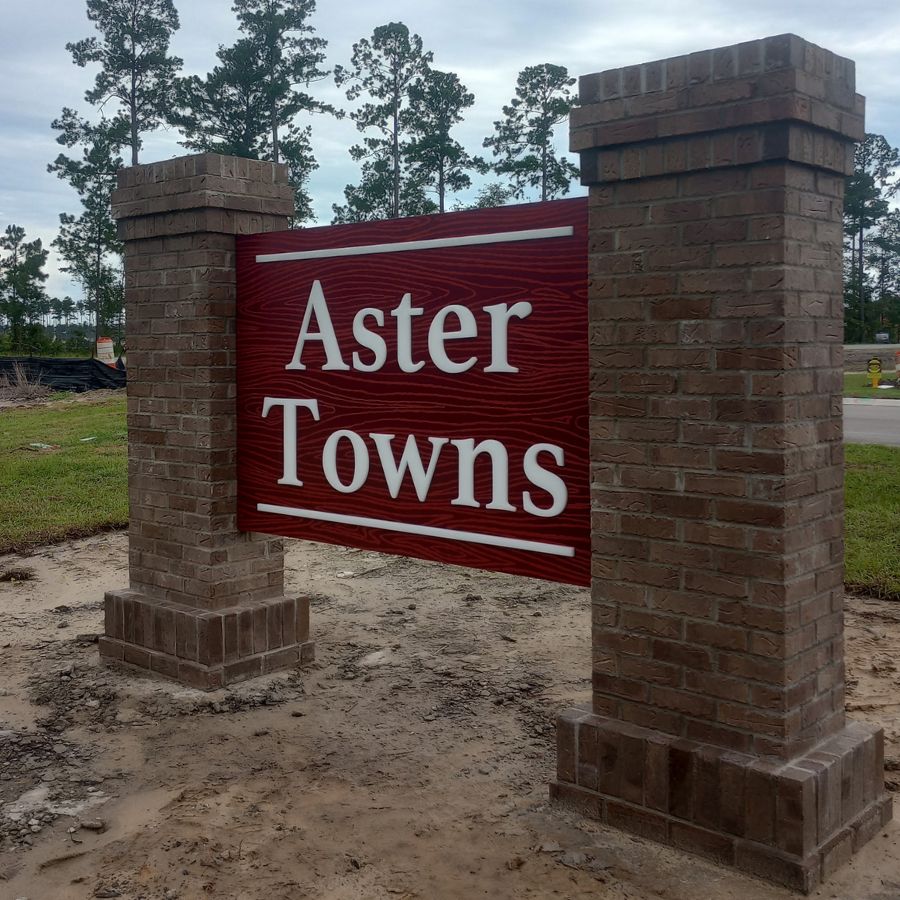
Pictured: Aster Towns community monument for Starlight Homes in Summerville.
Does an illuminated sign need more than a sign permit?
Usually, yes. The sign permit covers the sign itself: size, placement, height and appearance. The wiring is a separate trade and typically a separate permit. For an internally lit cabinet, a channel letter set, a halo-lit letter set or a monument with ground-mounted lighting, expect electrical permitting and an inspection of the connection by a licensed electrical contractor. Districts also commonly set rules on brightness, hours of illumination and whether an electronic message display is allowed at all. If lighting is part of your plan, raise it at the first conversation, not after fabrication starts.
What if the building is in a historic or overlay district?
Then there is usually a design review step before the permit. Where historic district or corridor overlay rules apply, a board or design reviewer looks at materials, lettering, color, mounting and lighting before a permit is issued, and that review runs on a meeting calendar. It is not a problem, but it is a date on the schedule, and it tends to favor simpler, more traditional sign treatments. If your address might be in one of these areas, find out early.
Do you need landlord or HOA approval first?
Very often, and it is the step that surprises people most. Sign applications normally need the property owner's authorization, so if you lease, your landlord has to sign off before the application is complete. Check your lease too, since many commercial leases spell out exactly what signage a tenant can install.
For neighborhood entrance monuments, community mailbox kiosks and amenity signs, the HOA or POA board is usually the approving body on the private side, and a developer may hold approval rights during buildout. Getting private and public approval in the right order keeps the project from stalling halfway.
What should you have ready before you apply?
- Property address and parcel identification
- The zoning district for the parcel
- A scaled drawing of the sign showing dimensions, materials, colors and copy
- A site plan or plot plan marking the sign location and setbacks
- Building frontage measurements for a wall or building-mounted sign
- Structural and footing detail for freestanding and monument signs
- Lighting detail and electrical information if the sign is lit
- Written property owner authorization, plus HOA or landlord approval where it applies
- Contractor information for whoever installs the sign and handles the electrical work
Assembling that package is most of the work. Incomplete applications are the usual reason a sign sits in review longer than it should, and a resubmittal costs more time than getting the drawing right the first time.
Is a monument sign reviewed differently than a wall sign?
Yes. A freestanding sign sits on the ground in front of the building, often near the right of way, so placement and height carry more weight. A wall sign is measured against the building it attaches to. The table shows where review attention typically goes. It describes the shape of the process, not local limits.
| Sign type | What review usually focuses on | Likely extra steps |
|---|---|---|
| Monument or freestanding sign | Height, sign area, setback from the right of way, sight lines at drives and corners, foundation | Structural and footing detail, site plan, electrical permit if lit |
| Wall sign or channel letters | Sign area against building frontage, projection from the wall, mounting method | Elevation drawing, attachment detail, electrical permit if lit |
| Tenant panel in a multi-tenant center | Conformance with the property's master sign plan plus the base district | Landlord and property management approval before filing |
| Window graphics and interior signs | Glass coverage and whether the sign is visible from the street | Often lighter review, but confirm the exemption instead of assuming it |
| Community entrance monument or mailbox kiosk | Placement in the common area, easements, setback, sight lines | HOA, POA or developer approval, plus any plat or easement check |
How long does a sign permit take, and what does it cost?
It depends on the jurisdiction, the review queue, whether design review is involved and whether your application is complete on the first pass. We are not going to put a number on it, because a wrong timeline turns into a missed opening date. Treat the sign as an early buildout item. Start the design and the zoning question while you are still permitting the space itself.
On cost, the Town of Summerville publishes a Planning fee schedule, and the counties publish their own, so your permit fee is a published number, not a guess. Ask for the current schedule when you confirm your zoning district, and budget the sign permit and any electrical permit as line items next to fabrication and installation.
What happens if a sign goes up without a permit?
Code enforcement can require the sign to be removed or modified, and you end up paying twice. An unpermitted sign can also cause friction at lease renewal, during a property sale and in an insurance claim after storm damage, which matters in a coastal market. Asking first always costs less than taking a sign down.
Does the sign company pull the permit, or the business owner?
It varies by shop. Some sign companies handle the whole submittal, some produce permit-ready drawings and let the owner or general contractor file, and some stay out of permitting entirely. Ask directly before you sign anything, because the answer affects your timeline and who is chasing the approval. Ask us when you call and we will tell you how it works for your project.
Whoever files, the material a reviewer needs (accurate dimensions, materials, mounting detail, lighting detail and a site plan) comes out of design and fabrication. Getting it right at the start is what keeps the application from bouncing back.
Working with Imperial Sign Crafters in Summerville
Imperial Sign Crafters is a sign shop at 709 Miles Jamison Rd, Suite 2 in Summerville, founded in 2017 by Matt Harris, who has more than 30 years in the sign industry. We design and build monument signs, exterior and interior business signs, vinyl signage, vehicle wraps, custom signage and community mailbox kiosks for businesses and communities across the Lowcountry. See the full list on our sign services page.
Our project gallery includes work for Bayer Heritage, Southern Cosmetic Laser, Millers Crossing on Johns Island, Tides in Park Circle, Aster Towns for Starlight Homes in Summerville, Coastal States Bank, Century 21, Plantation Dental Care, Meridian Metal Management and Actemium, along with community mailbox kiosks and pavilions.
If you are early in the process, tell us the address and what you want the sign to say. From there the conversation gets concrete: what the parcel is zoned, what type of sign fits, what the drawing needs to show and who has to approve it before anything is filed. Planning a project outside Summerville? See our pages for Charleston, North Charleston and Mount Pleasant.
Summerville sign permit questions
Do I need a permit for a business sign in Summerville, SC?
In most cases, yes. Permanent business signs, including monument signs, wall and building-mounted signs, channel letters, pylon signs and any illuminated sign, generally need a sign permit before installation. Face changes, maintenance and certain temporary or interior signs are often handled differently, so confirm your sign type with the office that has jurisdiction over your address.
Where do I apply for a sign permit in Summerville?
If the property is inside Town of Summerville limits, sign permits are a Planning Department application filed online through the Town's CitizenServe portal, which lists Sign Permit as its own application type. The Town asks applicants to contact the Planning Department before submitting. If the property is outside Town limits, the county with jurisdiction handles it.
Why are the sign size limits different for my building than for the business down the road?
Sign allowances are tied to the zoning district, not the business. The base district sets what you can do, and corridor overlays, planned development agreements, historic district rules and a multi-tenant property's master sign plan can all tighten it further. The same storefront sign can be approvable at one address and too large a mile away.
Does an illuminated sign need an electrical permit too?
Usually. The sign permit covers the sign, and the wiring is typically a separate permit with its own inspection, handled by a licensed electrical contractor. Local rules may also limit brightness, hours of illumination and whether an electronic message display is allowed, so bring lighting up at the design stage.
Do I need my landlord's approval for a sign on a leased building?
Almost always. Sign applications normally require the property owner's authorization, so a tenant sign needs the landlord's sign-off before the application is complete, and the lease itself often spells out what signage is allowed. In a shopping center or office park, a master sign plan may also control panel size, lettering and color.
How long does it take to get a sign permit in Summerville?
It depends on the jurisdiction, the review queue, whether design review is involved and whether the application is complete the first time. Treat the sign as an early buildout item and start the zoning question while you are still permitting the space, not in the last week before opening.
What happens if I install a business sign without a permit?
Code enforcement can require you to remove or modify the sign, which means paying once for the sign and again to fix it. An unpermitted sign can also cause problems at lease renewal, during a property sale and in a storm damage insurance claim.
Talk to a Summerville sign shop
We are in Summerville, so this is our home turf. Send the address and a photo of the building or site and we will walk through what it allows.
- Imperial Sign Crafters
- 709 Miles Jamison Rd, Suite 2, Summerville, SC 29485
- Phone
- (843) 926-7446
- imperialsigncrafters@gmail.com
Want to know what your address allows before you pay for design?
Send your address, a photo of the building or site, and a rough idea of the sign you have in mind. We will walk through it with you.